
Dry soup mixes are not usually the first foods backpackers consider when planning lightweight trail meals. Many hikers associate packaged soups with instant products designed for quick preparation rather than ingredient-based meals that can support multi-day food systems.
However, some dried soup mixes are structured very differently. Instead of being single-serving instant meals, they are designed to produce large batches of soup using whole dried ingredients such as grains, legumes, vegetables, and seasonings. When prepared at home and dehydrated again for trail use, these soups can become a practical base for reliable backpacking meals.

This approach works especially well when a soup mix produces multiple servings in a single batch. Rather than preparing individual meals one at a time, you can cook the full recipe at home, dehydrate it into compact portions, and create several lightweight trail meals from one package.
At the same time, soups like these still work very well in their original form for basecamp cooking and group trips. Because they typically produce large volumes and develop flavour through longer cooking times, they are well-suited to situations where weight is less critical and a larger shared meal is useful at the end of the day.
This article looks at how Mitchell’s Soup Company mixes can be used in both ways: as complete soups prepared at camp during basecamp-style trips, and as ingredient-based meals that can be cooked at home, dehydrated, and packed for lightweight backpacking use.
The example used here is their Beef Barley soup mix, which produces a large batch of soup and works particularly well as a candidate for dehydration and portioning into trail-ready meals.
About Mitchell’s Soup Company
Mitchell’s Soup Company is a Canadian producer of dry soup mixes built around whole ingredients such as grains, legumes, vegetables, and seasoning blends. Unlike instant soup packets designed for single servings, their mixes are intended to produce larger batches of soup that develop flavour through simmering rather than rapid preparation.
Mitchell’s Soup Company produces their mixes in small batches in Aylmer, Ontario. Many of the beans and legumes used in their soups are sourced from Canadian farms, while ingredients that cannot be grown in Canada, such as coconut, are sourced internationally. This ingredient-based approach is part of what gives their soups a structure that works well both for home cooking and for batch preparation ahead of camping and backpacking trips.
This ingredient-based structure makes their soups especially useful in situations where a full pot of food is practical, such as basecamp trips, group camping, or meal preparation at home before a trip. Because the mixes are shelf-stable and portionable after cooking, they can also be adapted into dehydrated trail meals.
My Personal Experience
I first started using Mitchell’s soup mixes at home several years ago. Last year, when I was planning earlier camping recipe articles, Mitchell’s Soup Company kindly provided several soup mixes for testing. I appreciated the opportunity to work with their products, and this article reflects my own experience using their soups over multiple seasons.
One of the soups that has stood out for me over time is their Mulligatawny soup, which has become a regular part of my home meal rotation and an example of how well their mixes work as ingredient-based dry pantry meals.
For this article, I am working with their Old Fashioned Beef Barley soup mix as a practical example of how a large-batch dry soup can be prepared at home, dehydrated, and adapted into backpacking-ready portions.
Why These Soup Mixes Work Well at Home and at Camp
Mitchell’s soup mixes are designed to produce full pots of soup using dried grains, legumes, vegetables, and seasoning blends rather than instant powders. Because of this structure, they behave more like ingredient-based pantry meals than quick single-serving soups.
Mitchell’s soup mixes have a shelf life of approximately 14 months when unopened. The “Best Enjoyed Before” date reflects peak flavour quality, particularly for the spices. After that point, the mixes remain usable, but seasoning strength may gradually decrease, and ingredients such as beans can take longer to fully cook.
Most of their soups typically require around two hours of simmering and produce approximately ten servings of about two cups each. That longer cooking time is part of what allows the ingredients to hydrate fully and develop flavour, and it also makes these mixes especially useful for batch cooking.
Useful for Home Meal Preparation
At home, these soups work well as practical dry pantry meals that can be prepared in advance and portioned for later use. Because each package produces a lot of soup, they are well-suited to cooking once and storing several servings in the refrigerator or freezer.
This same batch size also makes them ideal candidates for dehydration. Preparing a full pot at home and drying it into smaller portions allows a single package to become multiple lightweight backpacking meals with very little additional preparation.
The cooking instructions for Mitchell’s soup mixes are designed for standard kitchen conditions. As with many dried ingredient meals, longer cooking times may be required at higher elevations where water boils at lower temperatures.
Well-suited to Basecamp and Group Cooking
When prepared directly from the package at camp, these soups are best suited to situations where cooking time and pot size are less restricted. Canoe trips, basecamp-style setups, and group camps are good examples where a longer simmering meal can be practical and welcome at the end of the day.
Because the mixes produce a full pot of soup, they are especially useful when cooking for several people. Instead of preparing multiple individual meals, one package can provide a shared meal with minimal ingredient handling at camp.
NOTE: Soup mixes that produce larger batches are often more useful as basecamp meals when cooked from the package, but they can become very efficient backpacking meals when prepared at home and dehydrated into individual portions.
This combination of batch yield and ingredient structure is what makes mixes like the Beef Barley soup especially suitable for adapting into dehydrated trail meals.
My Experience Using Mitchell’s Soup Mixes Over the Past Several Years
I first started using Mitchell’s Soup Company mixes more than five years ago while experimenting with dry ingredient meals that could work both at home and during camping trips. Over time, they became a dependable option for preparing larger batch meals that store well and can be adapted for different trip styles.
One example was during a trip on the Bowron Lake Canoe Circuit, where I brought a portion of their Mulligatawny soup as part of a longer route meal plan. Because the full package produces a large pot of soup, I only packed part of the mix for that trip, which made it easier to match the meal size to a single paddler rather than a group.
I also describe the broader food strategy I used for that trip in more detail in Food Planning for the Bowron Lakes Canoe Circuit, where ingredient-based meals like this played an important role in managing food weight, cooking time, and meal flexibility across the full route.
Because canoe trips allow more flexibility with cooking time than most backpacking trips, I prepared the soup slowly over a campfire rather than using stove fuel. That longer cooking approach worked well for the ingredients in the mix and helped conserve fuel for later parts of the trip.
I also added green apples and freeze-dried chicken to increase both flavour and protein, which turned the soup into a more substantial evening meal after a full day on the water.
Experiences like this are where ingredient-based soup mixes tend to work especially well. They provide a structured base meal that can be adapted depending on the trip style, available cooking method, and the additional ingredients you choose to carry.
While these mixes are very practical for basecamp and canoe-style travel when prepared directly from the package, they also adapt well to a different workflow for backpacking. Because they produce a large batch when cooked, they can be prepared at home, dehydrated into smaller portions, and repacked into lightweight meals that are easier to carry on longer hiking routes.
Testing Mitchell’s Beef Barley Soup for Backpacking Use
To evaluate how well Mitchell’s soup mixes adapt to backpacking meals, I used their Beef Barley soup mix as a practical example of a batch-prepared soup that can be cooked at home, dehydrated, and repacked into trail-ready portions.
Beef barley soup is a useful test case because it includes a combination of grains, vegetables, and seasoning that normally require longer simmering to hydrate fully. Meals built from ingredients like these often perform well after dehydration because the cooking process at home allows the components to soften before drying.
Instead of trying to prepare the soup directly on the trail in its original form, the goal here was to follow a workflow that better suits backpacking travel. I also decided to create a Mitchell's Beef Barley soup recipe that everyone can follow:
- Cook the full batch at home
- Portion the finished soup for dehydration
- Dry the soup into a compact storage form
- Repackage individual servings
- Test how the soup performs when rehydrated
This approach turns a large-batch pantry-style soup into multiple lightweight trail meals that are easier to carry and faster to prepare during a trip.
Because each Mitchell’s soup package produces a substantial quantity of finished food, even a single batch can provide several backpacking meals once dehydrated and portioned properly. This makes mixes like Beef Barley especially useful when preparing food in advance of longer trips.
The next step in the process was preparing the soup at home according to the package directions so the ingredients could fully hydrate before dehydration.
Cooking the Soup Before Dehydrating
The first step in adapting the Beef Barley soup mix for backpacking use was preparing the soup at home according to the package directions. Because Mitchell’s soup mixes are built from dried grains, vegetables, and seasoning blends rather than instant ingredients, allowing enough simmering time is important before beginning the dehydration process.

The Beef Barley mix also includes optional ingredient suggestions on the package to help build a more complete soup. For this batch, I added cooked ground beef along with one cup of dehydrated diced celery and one cup of dehydrated diced carrots. These additions increased both the protein content and the vegetable structure of the finished soup before dehydration.
I also reduced the cooking water slightly from the suggested ten cups to eight cups. This produced a thicker finished soup that still allowed the ingredients to hydrate fully, but reduced the amount of moisture that needed to be removed during dehydration. When preparing meals for trail use, this kind of adjustment can make drying more efficient while still allowing additional water to be added later during rehydration if needed.
Because each package produces a large batch of soup, I divided the finished pot after cooking. Half was stored in the freezer for later use at home, while the remaining portion was prepared for dehydration. This makes it possible to turn a single package into both home meals and several backpacking portions at the same time.
Cooking the full batch ensures that ingredients such as barley and vegetables hydrate completely and develop the texture expected in the finished soup. This step is important because partially hydrated ingredients do not always dry or rehydrate evenly later.
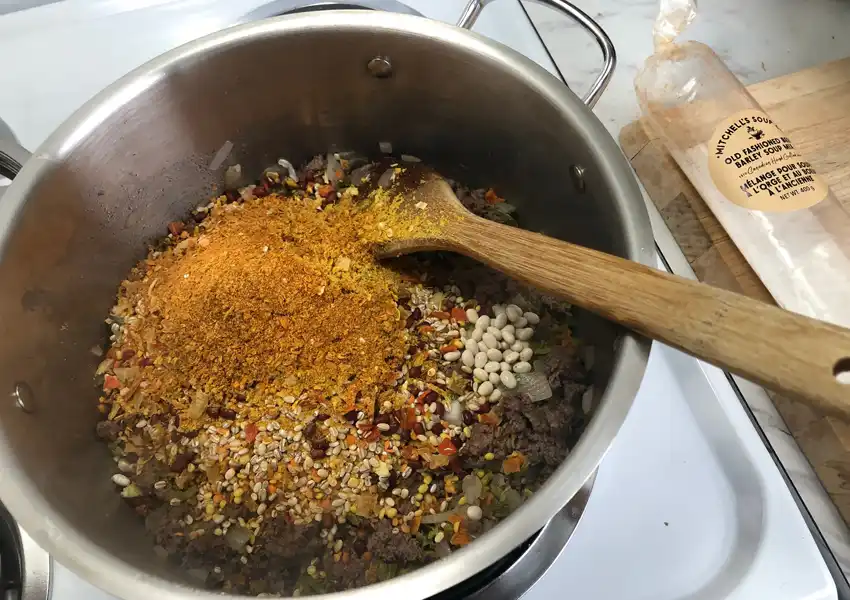
As the soup cooks, the ingredients gradually absorb water and expand into a thick, structured meal rather than a thin broth-style soup. This type of texture is generally well-suited to dehydration because the solids can be spread evenly on dehydrator trays and dried into compact portions.
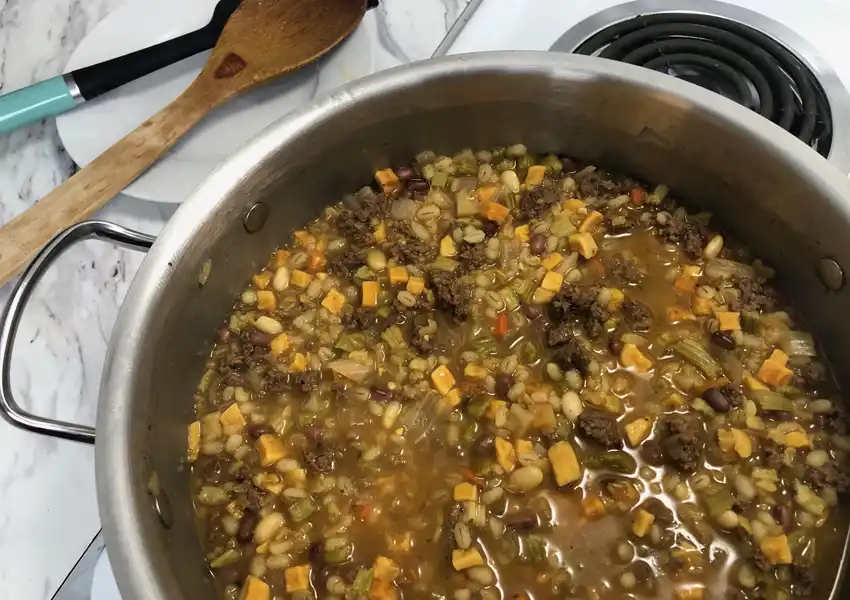
Preparing the entire batch at once also makes it easier to divide the soup into consistent portions after cooking. Since each package produces a large pot of soup, a single batch can usually be converted into several backpacking meals depending on portion size and trip requirements.
Before beginning dehydration, it helps to let the finished soup cool slightly so it can be handled more easily when spreading it onto dehydrator trays. At this stage, the goal is simply to ensure that the ingredients are fully hydrated and evenly mixed before moving on to drying.
NOTE: Cooking ingredient-based soup mixes fully before dehydration improves drying consistency and helps ensure the meal rehydrates more reliably on the trail.
Once the soup was fully cooked and the ingredients had softened, the next step was spreading portions onto dehydrator trays for drying.
Dehydrating the Cooked Soup for Trail Use
Once the soup was fully cooked and the ingredients were completely hydrated, the next step was preparing it for dehydration. Converting a large batch of soup into lightweight backpacking portions works best when the ingredients are spread evenly and dried in thin layers so moisture can escape consistently.
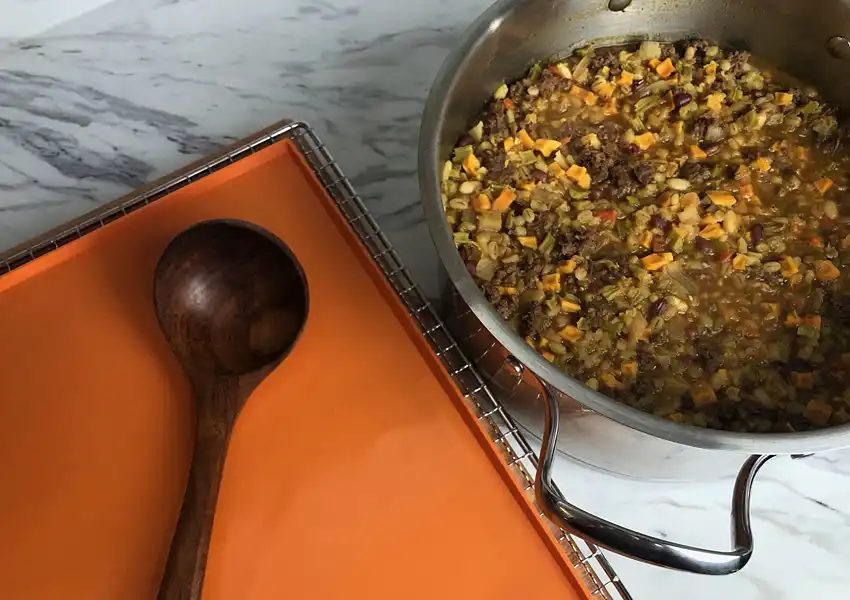
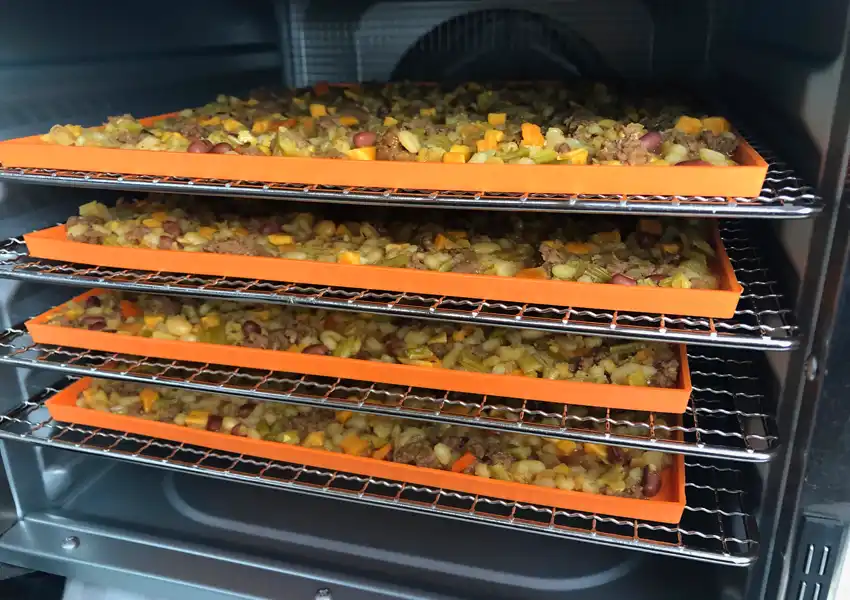
The portion prepared for dehydration filled four dehydrator trays when spread in shallow layers on silicone tray liners. Dividing the batch across multiple trays helped ensure the soup dried evenly while allowing good airflow around the ingredients.
The finished soup was portioned onto dehydrator trays lined with silicone non-stick sheets to prevent smaller ingredients such as barley and vegetables from falling through during drying. Spreading the soup in thin, even layers helps improve drying speed and produces pieces that are easier to portion later.
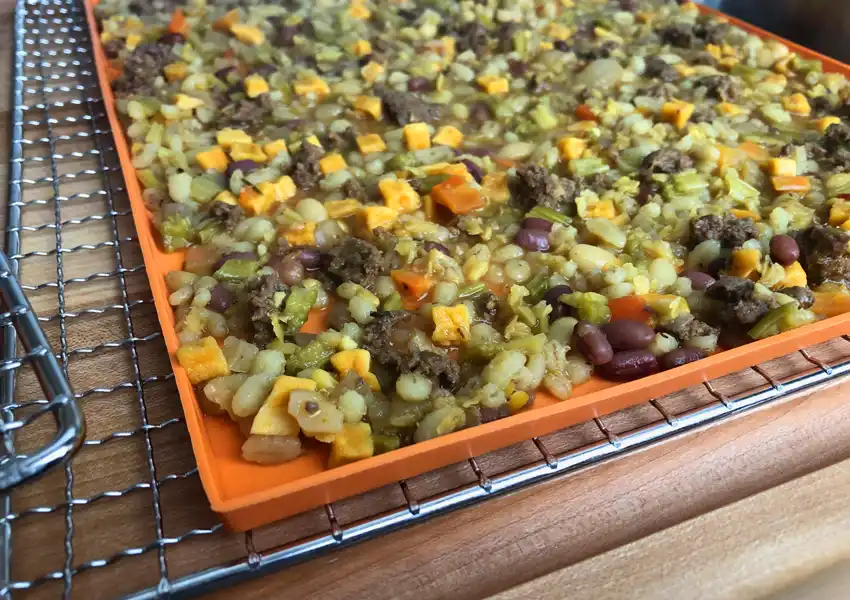
The dehydrator was set to 135°F (57°C), which is a typical temperature for drying cooked meals and ingredient-based soups. After approximately nine hours of drying, the trays were removed, and the partially dried soup was broken into smaller pieces to expose any remaining moisture and improve airflow across the ingredients.
The soup reached a fully dry texture after about twelve hours of total drying time. At that stage, the ingredients had formed dry crumbles and small chunks rather than flexible sheets, which made it easy to portion the soup into individual backpacking servings.
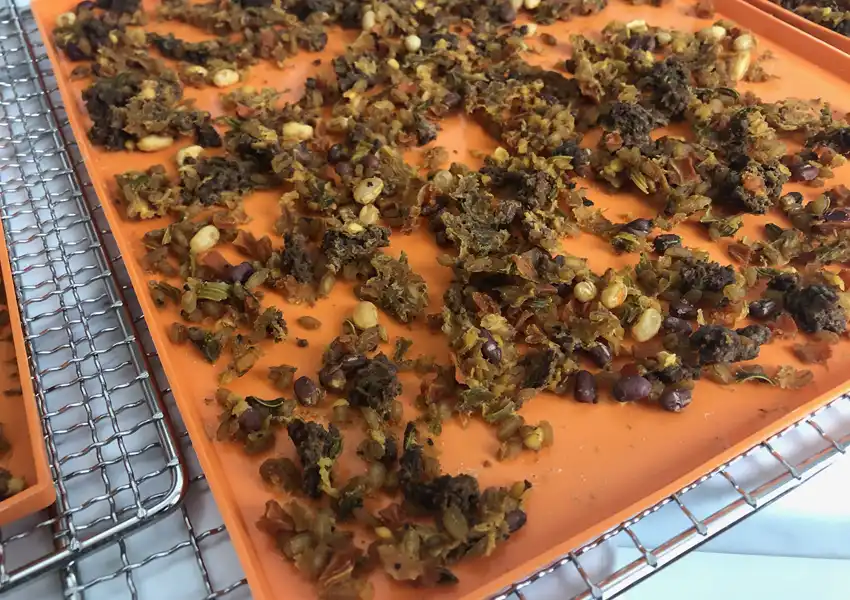
Ingredient-based soups like beef barley typically dry well because their structure comes from grains and vegetables rather than broth alone. This makes them strong candidates for batch dehydration when preparing meals ahead of time.
NOTE: Breaking partially dried soup into smaller pieces during dehydration helps expose trapped moisture and improves overall drying consistency, especially when working with grain-based meals like barley soups.
Once the soup was fully dry, it could be broken into compact portions sized for individual meals and packed into storage bags ready for trail use.
The final step was testing how well the dehydrated soup performed when rehydrated using typical backpacking cooking methods.
Rehydration Performance for Backpacking Use
After dehydration was complete, I tested how well the Beef Barley soup performed when rehydrated using several typical backpacking cooking methods. Because the original soup contains grains, vegetables, beans, and ground meat, rehydration performance depends partly on how much heat is applied during preparation on the trail.
For consistency, I tested a portion using approximately 1.5 cups of dehydrated soup with 1.5 cups of water in a 1:1 ratio. This produced a serving similar in thickness to the original soup after cooking.
| Method | Water Ratio | Time Required | Texture Result | Trail Practicality |
|---|---|---|---|---|
| Fresh (baseline comparison) | +½ cup of water | Immediate | Softest texture; identical to original cooked batch | Reference comparison only |
| Hot water soak | 1:1 ratio | ~20 minutes | Vegetables and barley rehydrated well; meat and beans were slightly firm | Best when conserving stove fuel |
| Simmer method | 1:1 ratio | ~10 minutes (12–15 minutes ideal) | Very close to original batch texture | Best overall backpacking method |
Rehydration Results: Simmering produced the closest match to the original soup at roughly 95% of the fresh texture. A hot water soak produced approximately 85% of the original texture and still worked well when conserving stove fuel.
In most backpacking situations, a short simmer provides the best balance between fuel use and meal quality, while soak-only preparation remains a practical backup option when conserving fuel.
Fresh Soup Comparison
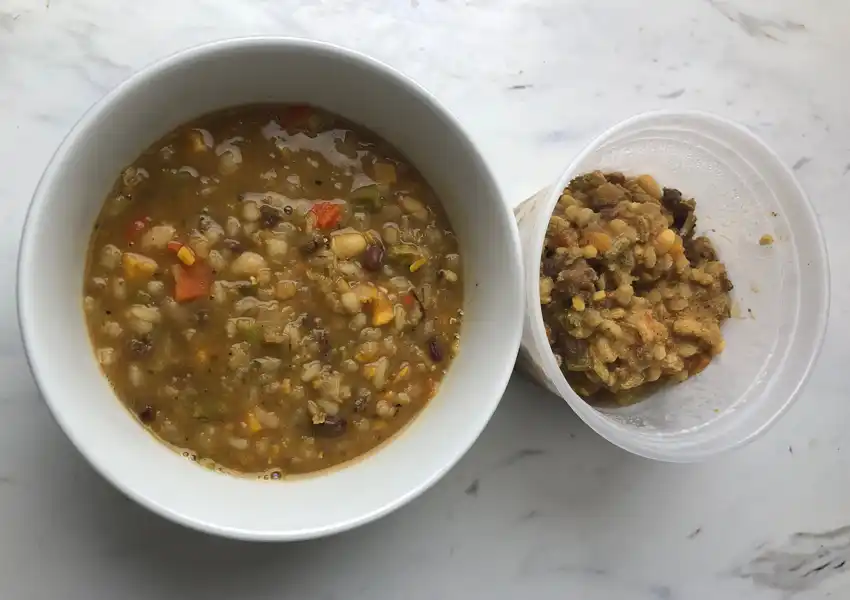
As expected, a portion taken directly from the original cooked batch produced the softest texture and most complete hydration across all ingredients. This served as the reference point when comparing the dehydrated versions.
Hot Water Soak Method
Rehydrating the dehydrated soup by adding boiling water and allowing it to soak for about 20 minutes produced a good result overall. Most ingredients softened well, although some of the meat and beans remained slightly firmer than in the freshly cooked version.
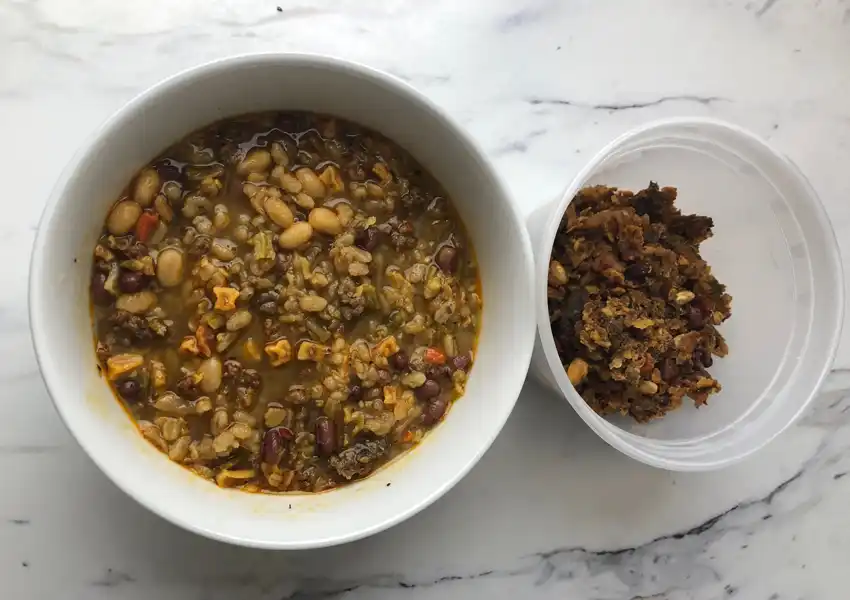
This method still produced a fully edible meal and would work well in situations where conserving stove fuel is important.
Simmering Method
Simmering the dehydrated soup for approximately 10 minutes produced a noticeably better result. The meat and beans softened more completely, and the overall texture more closely matched the freshly cooked soup.
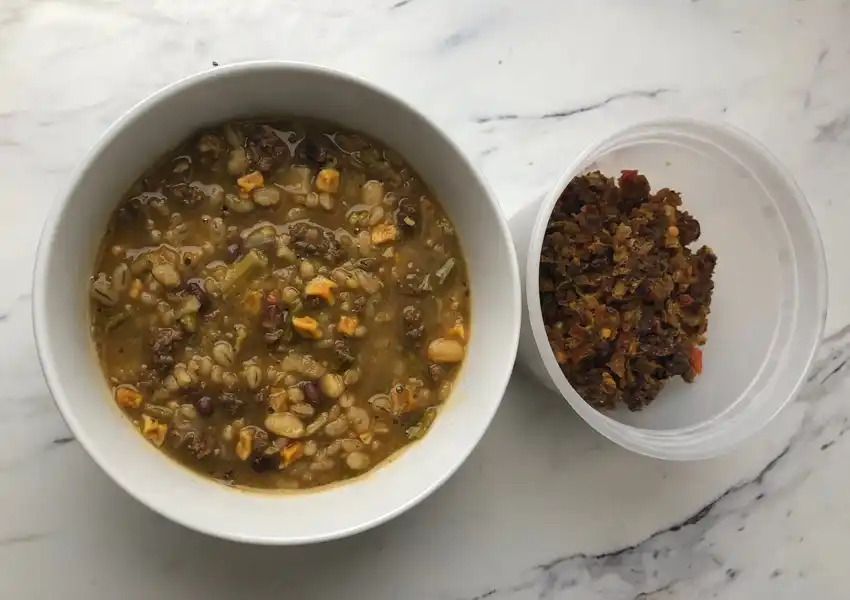
Extending simmer time to approximately 12 to 15 minutes would likely produce results very close to the original batch prepared at home.
Rehydration Results: In this test, simmering produced the closest match to the original soup at roughly 95% of the fresh texture, while a hot water soak produced approximately 85% of the original texture and still worked well as a fuel-saving preparation method.
These results suggest that dehydrated ingredient-based soups like this work well as backpacking meals when reheated with a short simmer, while still remaining practical as soak-only meals when stove fuel needs to be conserved.
When Mitchell’s Soup Mixes Make Sense for Different Trip Types
Ingredient-based soup mixes like those produced by Mitchell’s Soup Company can be useful in several different trip settings, depending on how they are prepared. Because each package produces a large batch of soup, they work especially well when matched to the right style of travel.
Basecamp and Group Camping
When prepared directly from the package, these soups are best suited to basecamp-style trips or group camping, where longer cooking times are practical. The larger batch size makes it easy to prepare a shared evening meal without carrying multiple individual meal packets.
Trips where a campfire is available are particularly well-suited to this style of cooking. Allowing the soup to simmer over a fire can reduce stove fuel use while producing a substantial meal at the end of the day.
Canoe and Paddling Expeditions
Canoe routes and paddling expeditions are another strong match for these soups in their original form. Because weight limits are usually less restrictive than backpacking trips, the longer simmer time and larger pot size become practical rather than limiting.
These types of trips also make it easier to carry additional ingredients that can be added to the soup to increase calories and protein when needed.
Backpacking Trips Using the Dehydration Method
For backpacking trips, preparing the soup at home and dehydrating it into individual portions is the most practical approach. This workflow converts a large-batch pantry-style soup into compact meals that cook faster and pack more efficiently.
Once dehydrated and portioned, soups like this become comparable to many homemade backpacking meals built from grains, vegetables, and protein ingredients. A short simmer produces the best results, although soak-only preparation remains a workable option when conserving stove fuel.
Practical takeaway: Mitchell’s soup mixes work best as basecamp meals when prepared directly from the package and as lightweight backpacking meals when prepared at home and dehydrated before a trip.
Using Mitchell’s Soup Mixes as Part of a Trail Food System
One of the strengths of ingredient-based soup mixes like these is that they fit naturally into a broader trail food system rather than functioning as single-use meals. Because each package produces a large batch, they can support multiple meals across both home preparation and backcountry trips.
Cooking a full pot at home allows part of the batch to be used immediately, while the remainder can be dehydrated and stored for future trips. This makes it possible to turn a single package into several backpacking meals while still keeping portions available for basecamp cooking or regular home use.
Meals structured around grains, vegetables, and protein ingredients also adapt well to customization. Adding ingredients such as additional dehydrated vegetables, freeze-dried meat, or calorie-dense fats allows the same soup base to support trips with different energy requirements.
This type of flexibility is one of the reasons ingredient-based meals remain useful across multiple styles of travel. Instead of relying entirely on single-serving packaged meals, it becomes possible to build a pantry system that supports both short trips and longer routes using the same core ingredients.
In this case, preparing the Beef Barley soup mix at home and dehydrating it into individual portions produced a dependable backpacking meal that retained most of the texture and structure of the original soup while becoming much easier to carry and prepare on the trail.
Final Assessment of Mitchell’s Soup Company Mixes for Camping and Backpacking
After several years of using Mitchell’s Soup Company mixes both at home and during trip preparation, they have proven to be reliable ingredient-based meals that adapt well to different styles of camping travel.
Prepared directly from the package, they are best suited to basecamp cooking and paddling trips where longer simmer times are practical and a larger shared meal is useful. Their structure and batch size make them especially well-suited to these situations.
For backpacking trips, preparing the soup at home and dehydrating it into individual portions produces a much more efficient trail meal. In testing, the dehydrated Beef Barley soup rehydrated well using both soak-only and short simmer methods, with simmering producing results very close to the original batch.
Because the mixes are built from grains, vegetables, and seasoning blends rather than instant powders, they also integrate naturally into a broader pantry-style approach to trip food planning. This makes them useful not only as individual meals but also as part of a larger system for preparing food ahead of time.
Used this way, Mitchell’s soup mixes provide a practical option for campers, paddlers, and backpackers who prefer ingredient-based meals that can be prepared at home and adapted for reliable use in the backcountry.
Trail meals work best when they are simple to prepare, reliable to rehydrate, and efficient to carry over multiple days. These guides explain how complete meals function in real backcountry conditions and how to build meals that perform well on hiking and paddling trips.
Trying to build better trail meals for your next trip? Follow Trail Eating on Facebook for more meal ideas and to join the discussion.