
Recipe Details
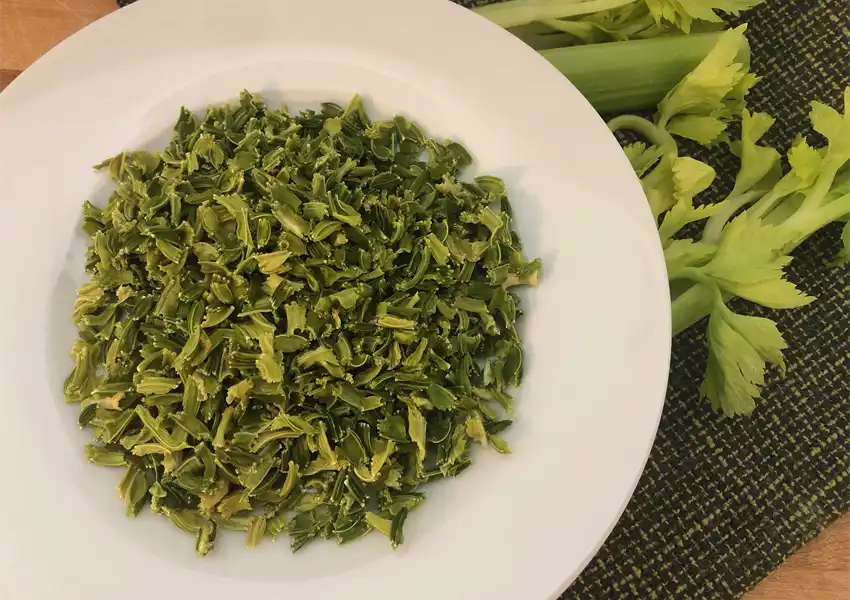
Dehydrated celery is a lightweight vegetable ingredient that works well in many backpacking meals. When properly dried, celery keeps much of its flavour while taking up very little space in a food bag.
Prep Time
20min
Cook Time
10h
Wait Time
15min
| Characteristic | Details |
|---|---|
| Difficulty: | Easy |
| Cost: | Cheap |
| Category: | Dehydrated Ingredients |
| Seasons: | All |
Ingredients
Ingredients & Servings: Easily customize your meal with our adjustable servings slider. The ingredient list dynamically updates, ensuring perfect portions for your camping adventure, whether solo or with a group.
Celery
| 1 Stalk | Large Celery |
Dehydrated Celery Directions
Celery is commonly used as part of the flavor base for soups, stews, rice dishes, stuffing-style meals, and noodle dishes. It is especially useful when combined with dehydrated carrots and onions to create a classic soup base often used in backcountry cooking.
This recipe explains how to prepare and dehydrate fresh celery so it stores well and rehydrates reliably for use in trail meals.
Step 1:
Wash the celery ribs thoroughly under cold running water to remove any dirt or debris. Pat the celery dry with a paper towel.

For this batch, one full celery stalk was used. After trimming and preparation, the celery weighed 780 g (28 oz) before dehydration.
Step 2:
If desired, remove the stringy veins from the celery ribs before cutting. To do this, make a small cut near one end of the rib with a paring knife just under the stringy fibres. Pull downward along the rib to remove the strings.


Removing the veins improves the texture and appearance of dehydrated celery and prevents stringy pieces in finished meals.
Step 3:
Slice the celery ribs lengthwise into narrow strips, then dice them into pieces approximately ½ inch in size. Keeping the pieces consistent helps them dry evenly in the dehydrator.

Step 4:
Blanch the celery to help preserve colour and improve rehydration. In this batch, the celery was placed in a large saucepan over low heat and gently sweated until the natural moisture released steam.

This steaming process lightly precooks the celery and acts as a blanching step without immersing the vegetables in boiling water.

Step 5:
Spread the diced celery evenly across the dehydrator trays in a single layer. Avoid stacking or overlapping the pieces so air can circulate freely around the vegetables.

Step 6:
Set the dehydrator temperature to 130°F (55°C). Dry the celery until the pieces become brittle and snap easily when bent.
Drying time typically ranges from 6–10 hours, depending on humidity, airflow, and the size of the pieces. Rotate trays if needed to promote even drying.
Step 7:
Allow the celery to cool completely at room temperature before storing it. Cooling prevents condensation from forming inside storage containers.
Store the dried celery in airtight containers, vacuum-sealed bags, or freezer bags in a cool, dark location.
Recipe Notes
Batch size
- Batch size
This batch used 780 g (28 oz) of prepared celery. - Finished yield
After dehydrating, the celery weighed 39 g (1.4 oz). - Water removed
A total of 741 g of water was removed during the dehydration process. - Number of servings
Serving sizes are based on the fresh equivalent weight. One serving equals approximately 28 g (1 oz) of fresh celery. This batch produces about 28 servings. - Dried serving size
Each serving equals approximately 1.4 g of dried celery. - Rehydration
The celery has a rehydration ratio of approximately 19:1. Each serving requires about 27 g of water (roughly 2 tablespoons) to fully rehydrate. - Blanching method
Instead of boiling the celery, the pieces were gently heated in a saucepan over low heat so the natural moisture released steam. This process lightly precooks the celery and acts as a blanching step that helps preserve colour and improve rehydration. - Optional deveining step
Removing the stringy fibres from celery ribs before dicing can improve the texture and appearance of dehydrated celery and reduce the chance of tough pieces in finished meals. - Using dehydrated celery in trail meals
Celery works well in soups, ramen, rice dishes, stuffing-style meals, and many dehydrated dinners. It is often combined with dehydrated carrots and onions to create a classic soup base for backpacking meals. - Storage
Store dehydrated celery in airtight containers or vacuum-sealed bags in a cool, dark location. Properly dried celery typically stores well for 6–12 months, and longer if kept in the freezer. - Further reading
Ultimate Guide to Dehydrating Food for Backpacking
Nutrition facts
Serving size 1.4 grams vegetarian Vegan gluten free lactose free
Per Serving
| Kcal: | 4 kcal |
| Fibers (g): | 0.5g |
| Sodium (mg): | 22mg |
| Carbs: | 0.8g |
| Sugar (g): | 0.4g |
| Fat: | 0.1g |
| Proteins: | 0.2g |