
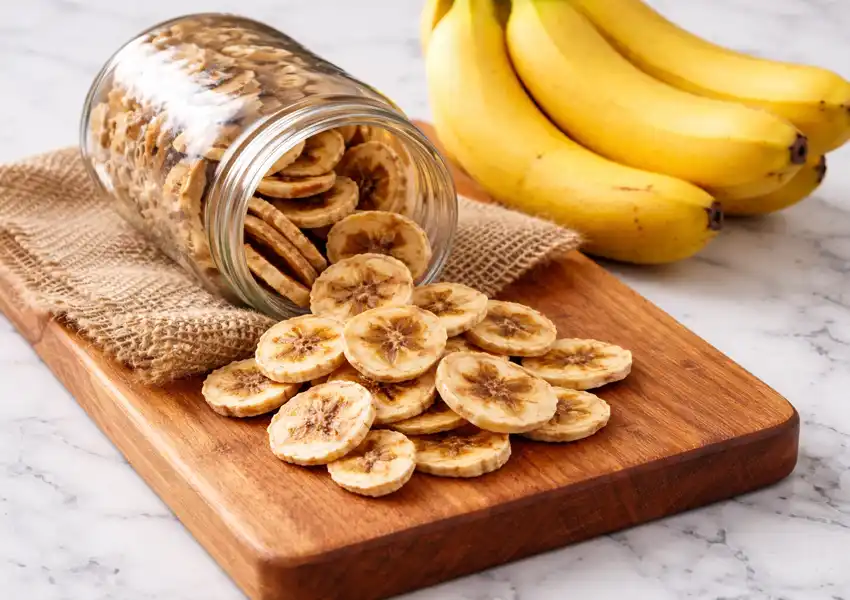
Recipe Details
Dehydrated bananas are a lightweight fruit ingredient commonly used in backpacking meals. When dried properly, banana slices retain much of their natural sweetness and flavour while becoming shelf-stable and easy to pack.
Prep Time
10min
Cook Time
8h
Wait Time
15min
| Characteristic | Details |
|---|---|
| Difficulty: | Super easy |
| Cost: | Cheap |
| Category: | Dehydrated Ingredients |
| Seasons: | All |
Ingredients
Ingredients & Servings: Easily customize your meal with our adjustable servings slider. The ingredient list dynamically updates, ensuring perfect portions for your camping adventure, whether solo or with a group.
Bananas
| 5 Each | Bananas |
| 1 cup | Warm water |
| 1/4 cup | Lemon Juice |
Dehydrated Bananas Directions
Dried bananas work well in trail foods such as oatmeal, granola mixes, trail mix, and dessert-style camp meals. They can also be eaten on their own as a simple high-carbohydrate trail snack.
This recipe explains how to prepare and dehydrate bananas for backpacking meals, including simple methods to help reduce browning during dehydration.
Step 1:
Select bananas that are mostly yellow but still slightly firm. Bananas that are about 70% ripe (yellow with some green remaining on the peel) tend to slice more cleanly and dry more evenly than fully ripe bananas.
Step 2:
Peel the bananas and slice them into uniform pieces about 1/4 to 3/8 inch thick. Keeping the slices consistent helps the fruit dry evenly.
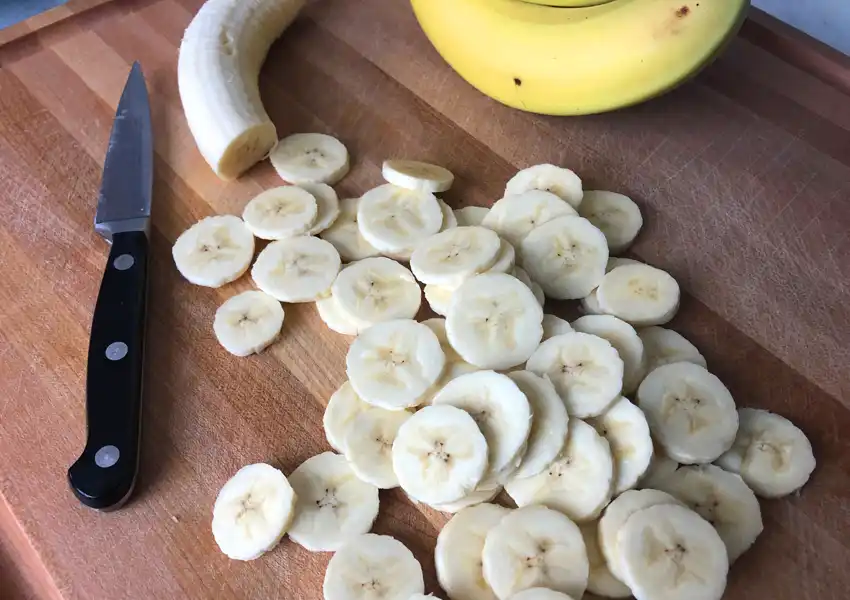
For this batch, five bananas were used. After peeling, the prepared bananas weighed approximately 375 g (13 oz).
Step 3:
To help reduce browning, prepare a lemon water bath by mixing 1 cup of warm water with 1/4 cup lemon juice.
Dip the banana slices briefly in the mixture, then remove and allow any excess liquid to drain before placing the slices on dehydrator trays.
Step 4:
As an optional alternative, banana slices can also be dipped in a warm water and maple syrup 1:1 mixture before drying. This can add a subtle sweetness and may help preserve colour, but if you want more maple sweetness, brush on pure maple syrup.
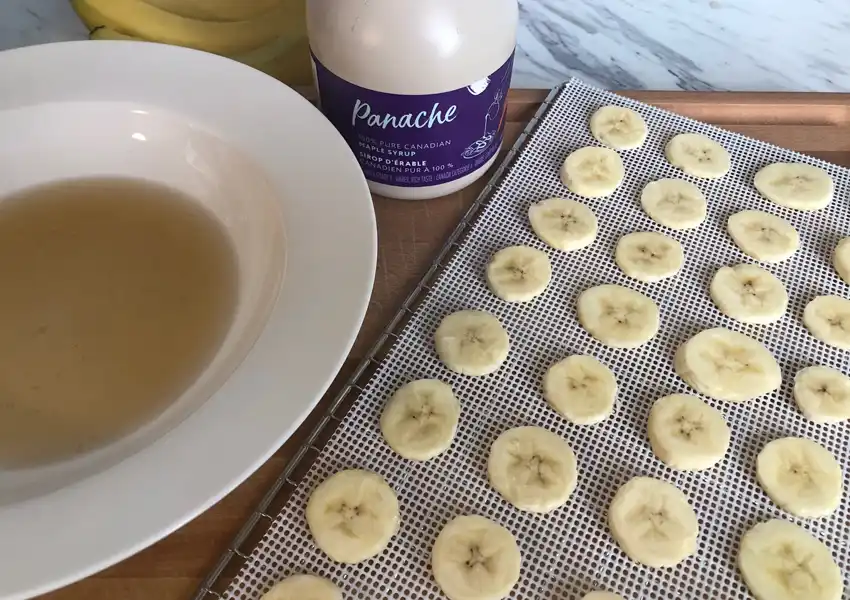
Step 5:
Arrange the banana slices on the dehydrator trays in a single layer. Avoid overlapping the slices so air can circulate freely around the fruit.
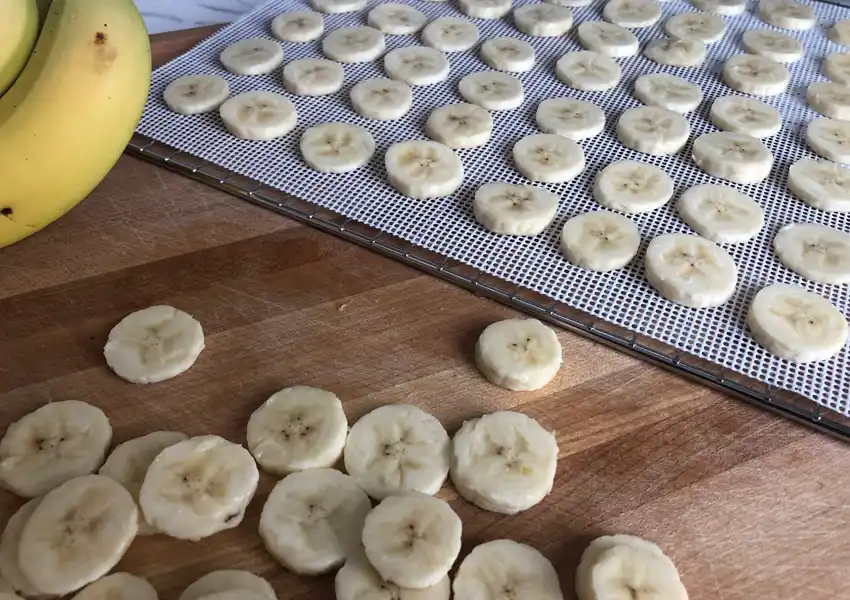
Step 6:
Set the dehydrator temperature to 130°F (55°C). Dry the bananas until they become leathery and slightly firm. This typically takes 6–8 hours, depending on humidity, airflow, and slice thickness.
If slices begin sticking to the trays, gently flip them partway through the drying process. I recommend a silicon mesh sheet.
Step 7:
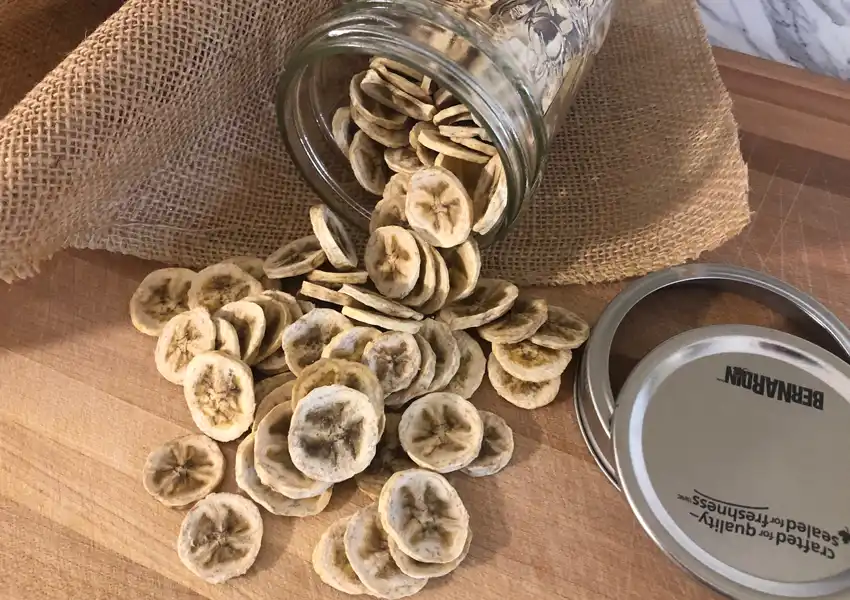
Allow the dried banana slices to cool completely at room temperature before storing them.
Store dehydrated bananas in airtight containers or vacuum-sealed bags in a cool, dark location.
Recipe Notes
- Batch size
This batch used 5 bananas. After peeling, the prepared bananas weighed approximately 375 g (13 oz). - Finished yield
After dehydrating, the banana slices weighed 112 g (4 oz). - Water removed
A total of 263 g of water was removed during the dehydration process. - Number of servings
Serving sizes are based on the fresh equivalent weight. One serving equals one medium banana. This batch produces 5 servings. - Dried serving size
Each serving equals approximately 22 g of dried banana slices. - Rehydration
The bananas have a rehydration ratio of approximately 2.3:1. Each serving requires about 53 g of water (roughly 3½ tablespoons) to fully rehydrate. In many trail meals, such as oatmeal, the bananas can simply be added directly to the pot during cooking. - Drying time
Bananas dried to a chewy texture in about 6 hours. After approximately 8 hours, the slices became crisp and snapped when broken. - Anti-browning test
Three preparation methods were tested: untreated slices, slices dipped in lemon water, and slices brushed with maple syrup. All three produced similar colour results after dehydration. - Flavor test
The slices lightly coated with maple syrup produced the best flavour and sweetness while drying equally well. - Ripeness recommendation
Slightly under-ripe bananas (about 70% ripe with a small amount of green on the peel) slice more easily and dry more evenly than fully ripe bananas. - Using dehydrated bananas in trail meals
Dried bananas work well in oatmeal, granola, trail mix, dessert-style couscous, and other backpacking meals. They can also be eaten directly as a trail snack. - Storage
Store dehydrated bananas in airtight containers or vacuum-sealed bags in a cool, dark location. Properly dried bananas typically store well for several months and even longer if kept in the freezer. - Further reading
Ultimate Guide to Dehydrating Food for Backpacking
Nutrition facts
Serving size 22 grams vegetarian Vegan gluten free lactose free
Per Serving
| Kcal: | 67 kcal |
| Fibers (g): | 2g |
| Sodium (mg): | 1mg |
| Carbs: | 17g |
| Sugar (g): | 9g |
| Fat: | 0.2g |
| Proteins: | 0.8g |